TL;DR
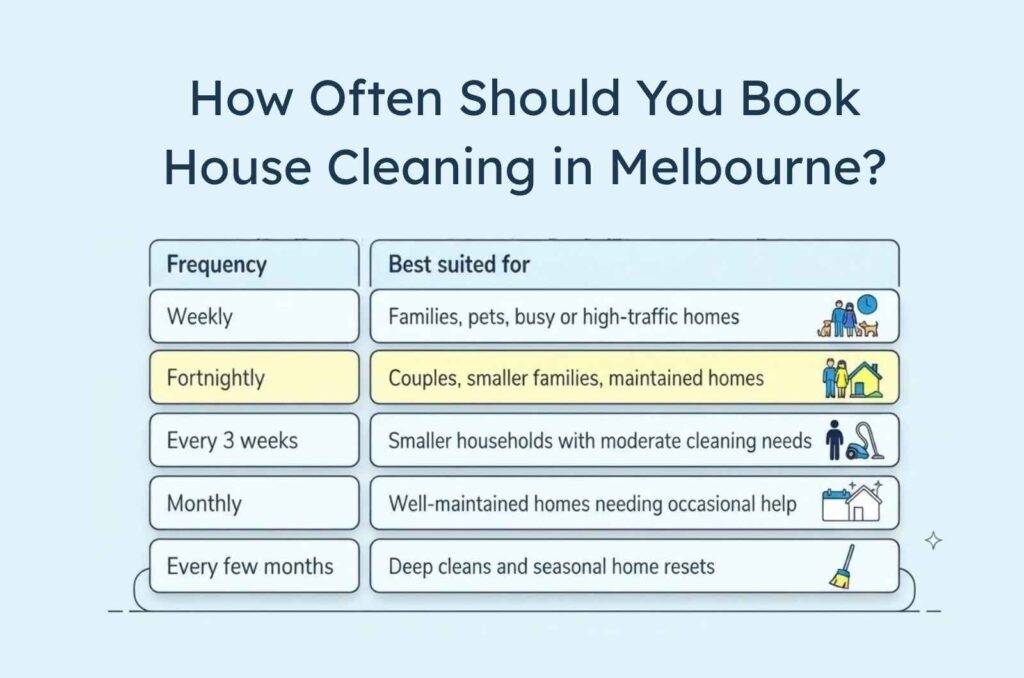
For most Brisbane homes, professional window cleaning is recommended every 3 to 6 months. Properties near the coast, heavily vegetated areas, or busy roads may need cleaning every 6 to 8 weeks due to salt air, pollen, and traffic grime. Brisbane's subtropical climate, with its high humidity, intense summer storms, and significant pollen load from spring jacarandas and subtropical flowering trees, means windows accumulate dirt faster here than in drier Australian cities. The right frequency depends on your property type, location, and exposure to local environmental conditions.
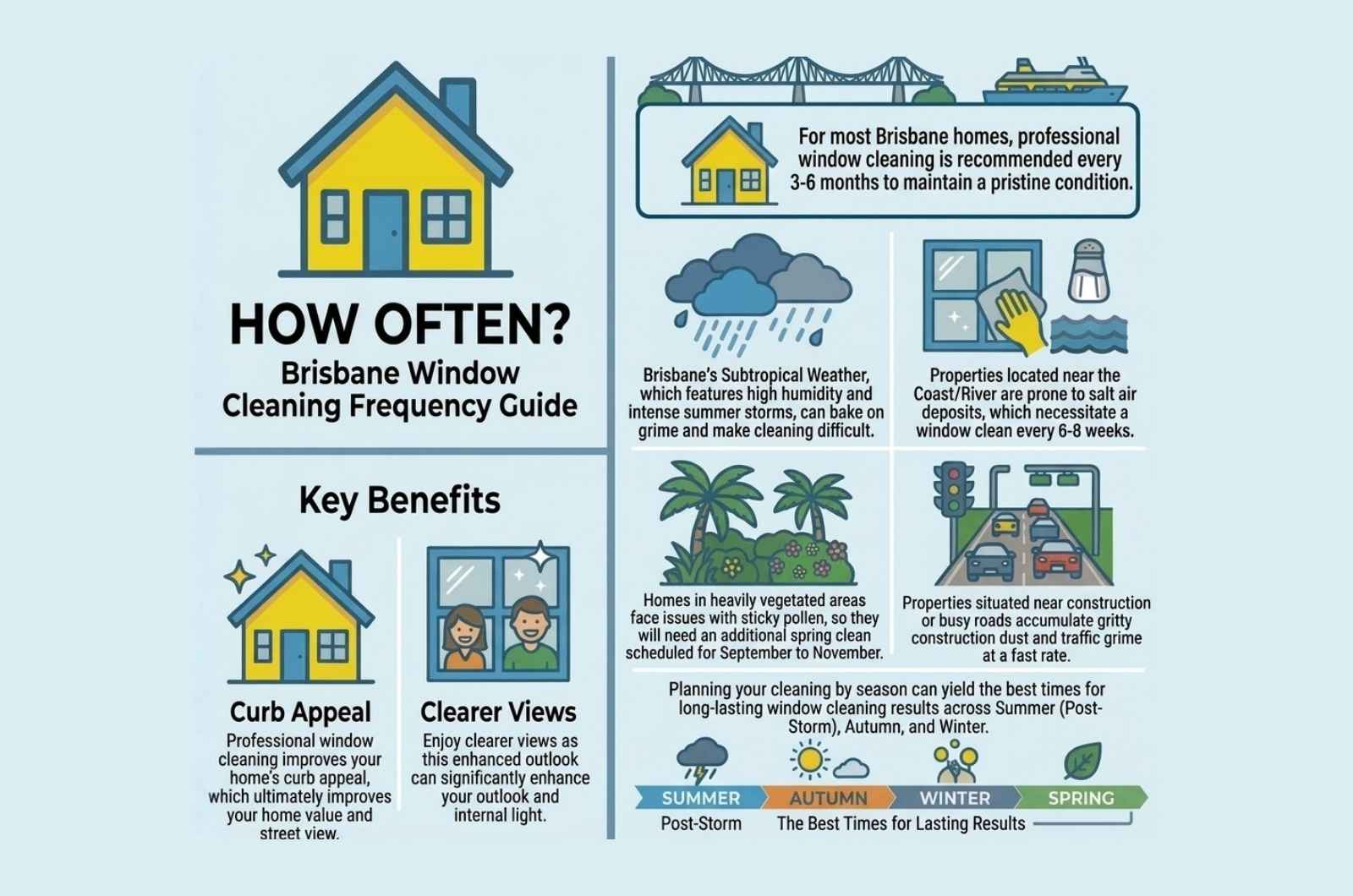
Anyone who lives in Brisbane knows the city does not sit still weather-wise. Brisbane enjoys a subtropical climate defined by warm or hot weather for most of the year, with its highest rainfall occurring during summer and average humidity ranging from around 64% in winter months to 72 to 75% through the peak summer months of January and February.
That combination of heat, humidity, and seasonal rainfall creates a perfect recipe for window grime. Rain does not simply wash windows clean. Rainwater picks up dust, pollen, and atmospheric particles on the way down and deposits them directly onto glass surfaces. Once the water evaporates in Brisbane's warm temperatures, those particles are left behind as streaks, spots, and a dull film.
Brisbane receives an average of around 1,031mm of rain annually, with year-to-year variation ranging from under 900mm in dry years to well over 1,100mm in wetter ones. That means window contamination from rain is a year-round issue, not just a wet-season problem.
Brisbane receives around 3,000 hours of sunshine per year, making it one of Australia's sunniest major cities. That abundant sunshine is great for lifestyle, but UV exposure also degrades the clarity of glass over time, baking on grime and accelerating the buildup of mineral deposits when combined with Brisbane's intermittent rain.
How Often Should Brisbane Homeowners Have Their Windows Cleaned?
The honest answer is that there is no single frequency that suits every Brisbane property. The right schedule depends on the specific environmental conditions your windows are exposed to.
Here is a practical guide broken down by property type and location.
Standard Residential Homes in Brisbane Suburbs
For a typical Brisbane house or townhouse located in a suburban area away from the coast, every 3 to 6 months is the recommended baseline for professional home window cleaning. This accounts for:
- Brisbane's wet season runs from November to April, during which the city's wettest months (January through March) each average around 150 to 160mm of rainfall, leaving significant water marks and grime on glass surfaces after every storm cycle.
- The dry winter months from June to August, which bring their own contamination in the form of dust, fine particles, and suburban pollen. Brisbane's winter is generally dry and mild, but reduced rainfall means dust settles on windows without being disturbed, creating a dull buildup over weeks.
- A schedule of two professional cleans per year (typically at the end of the wet season in May and again heading into summer in October or November) works well for most standard suburban homes across Brisbane's inner and outer suburbs.
Homes Near the Brisbane River or Moreton Bay Coastline
Coastal and waterfront properties face significantly faster window contamination than inland homes. Salt-laden air from Moreton Bay, the Brisbane River estuary, and the surrounding bay breeze corridors deposits a fine salt film on glass that is invisible at first but rapidly attracts grime and creates a milky haze if left untreated.
For homes within 2 kilometres of the waterfront, including suburbs like New Farm, Teneriffe, Hamilton, Bulimba, Manly, and bayside communities such as Wynnum and Redcliffe, professional residential window cleaning every 6 to 8 weeks is a realistic maintenance requirement. Salt residue left on glass for extended periods can etch the surface, causing permanent damage that no amount of cleaning will reverse.
Properties in Heavily Vegetated or Bushland Areas
Brisbane and its surrounding regions are home to exceptional botanical diversity. Brisbane and South East Queensland have a high botanical diversity and associated high pollen load, particularly in spring when jacarandas, poinsettias, and subtropical flowering trees release significant quantities of pollen.
Pollen is one of the most stubborn window contaminants because it is sticky by nature, clinging to glass and building up in layers. For homes surrounded by established gardens, near parklands, or backing onto bushland reserves, windows can become noticeably hazy with pollen within two to three weeks during the peak spring season (September to November).
For these properties, cleaning every 2 to 3 months is recommended, with an additional targeted clean at the end of spring to address the season's pollen peak.
Apartments and High-Rise Properties in Brisbane's Inner City
Brisbane's inner-city apartment market has grown substantially, and high-rise and mid-rise apartments face a specific set of window contamination challenges. At elevation, windows are exposed to stronger winds that carry atmospheric dust and particulate matter across the city. Traffic pollution from Brisbane's major arterial roads and the CBD also contributes a greasy film of fine particles that settles on glass.
For apartment buildings, window cleaning frequency is typically managed through a body corporate arrangement, with professional domestic window cleaning services scheduled every 3 to 6 months for the building as a whole. Individual apartment owners or tenants should confirm their building's schedule and consider supplementing with an internal window clean in between.
Properties Near Construction Sites or Busy Roads
Construction activity in Brisbane has been ongoing and significant, particularly in the inner city and growth corridors of the north and south. Properties near active construction sites are exposed to concrete dust, silica particles, and general construction debris that coats windows in a gritty layer. Similarly, homes directly fronting busy main roads accumulate traffic exhaust and tyre-rubber particles on their windows faster than properties on quieter streets.
For these situations, quarterly or even monthly professional window cleaning services in Brisbane may be warranted until the local environmental factor is resolved.
Brisbane's Seasonal Window Cleaning Calendar
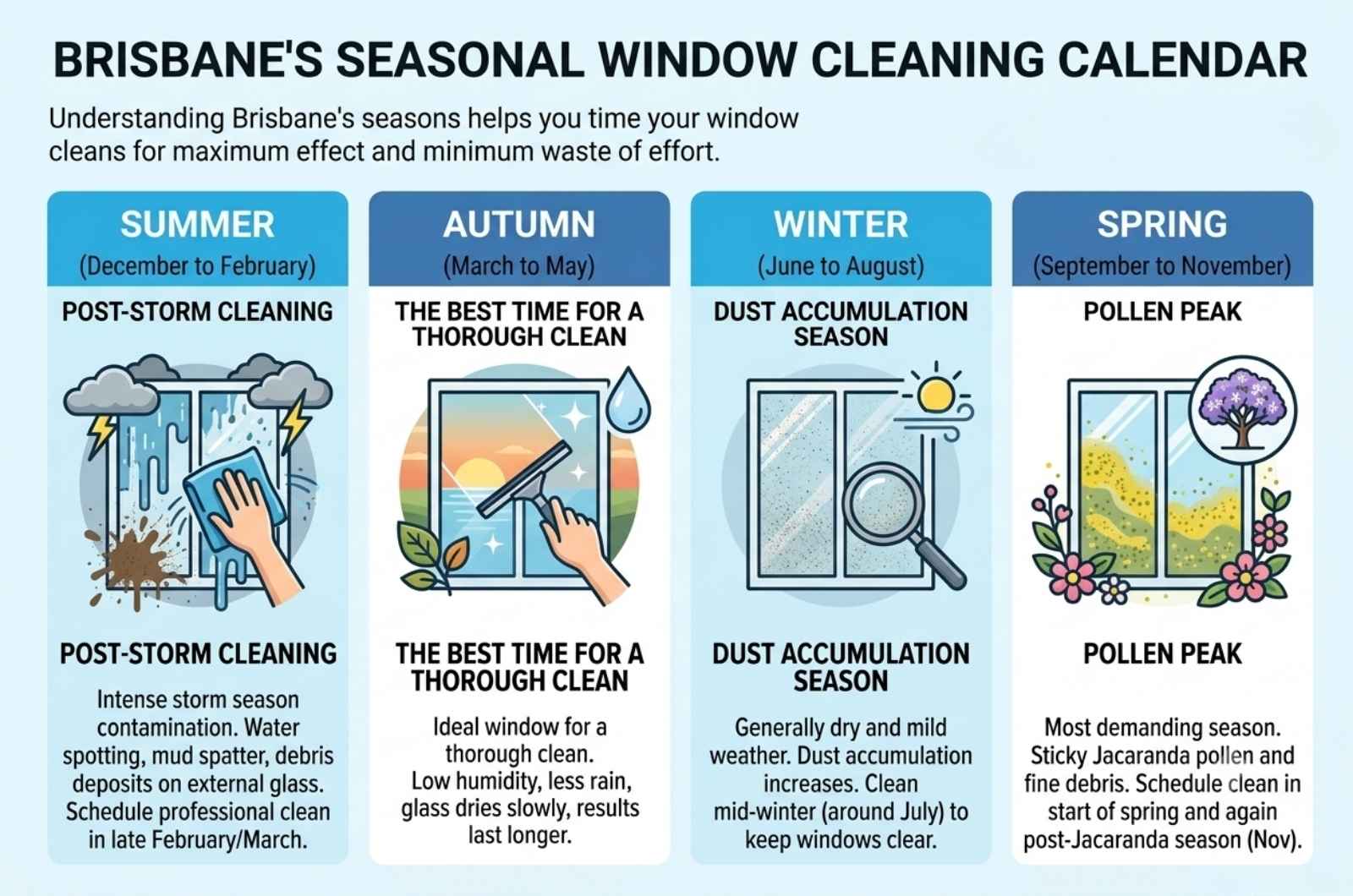
Understanding Brisbane's seasons helps you time your window cleans for maximum effect and minimum waste of effort.
Summer (December to February): Post-Storm Cleaning
Brisbane's summer storm season is the most intense period for window contamination. Heat-born precipitation and thunderstorms are common during summer days, with humidity often reaching over 80%, and major storm events leave behind significant water spotting, mud spatter, and debris deposits on external glass. A professional clean after the major summer storm period in late February or March makes good practical sense.
Autumn (March to May): The Best Time for a Thorough Clean
Autumn signals the end of the hot summer when average temperatures drop, and the city experiences low humidity and less rain. This is the ideal window for a thorough professional clean. Glass dried slowly in lower humidity is less prone to water spotting during the cleaning process, and the reduced rain means results last longer before the next contamination cycle begins.
Winter (June to August): Dust Accumulation Season
Brisbane's weather in winter is generally dry and mild. Less rain means less storm-related soiling, but dust accumulation increases. Fine particles settle on glass during extended dry periods without rain to disturb them. A mid-winter clean around July keeps windows clear through Brisbane's best outdoor weather period.
Spring (September to November): Pollen Peak
Spring is the most demanding season for windows in Brisbane. Jacaranda trees, one of Brisbane's signature street trees, produce substantial pollen and fine debris when flowering in October and November. Combined with the general subtropical spring pollen load, this is the period when windows in garden-facing or park-adjacent homes degrade fastest. Scheduling a professional clean at the start of spring and again after the jacaranda season ends in November is a smart approach for affected properties.
What Happens If You Leave Windows Too Long Between Cleans?
Neglecting window cleaning for extended periods in Brisbane's environment creates problems that go beyond aesthetics.
- Hard water mineral deposits from Brisbane's tap water and rain leave calcium and silica deposits on glass that become increasingly difficult to remove over time. Left for more than 12 months, these deposits can etch permanently into the glass surface, reducing clarity in a way that cannot be cleaned away.
- Salt etching on coastal properties progresses in a similar way. A salt film that is regularly removed is a cosmetic issue. Salt film allowed to sit through multiple heat and humidity cycles becomes a chemical process that gradually damages the glass itself.
- UV magnification through dirty glass is a lesser-known issue. A thick film of grime or hard water deposits on windows can create uneven light magnification that, in extreme cases, concentrates heat onto internal surfaces, including furnishings and blinds.
- Reduced natural light in the home affects both comfort and energy use. Grime-coated windows can reduce the amount of natural light reaching interior spaces by a measurable amount, shifting more load onto artificial lighting.
DIY Window Cleaning vs Professional Window Cleaning in Brisbane
Many Brisbane homeowners attempt DIY window cleaning, and for ground-floor accessible windows, it is entirely practical. However, there are clear situations where professional domestic window cleaning in Brisbane is the better choice.
- Access and safety are the primary considerations. Brisbane homes, particularly Queenslander-style homes elevated on stumps, often have windows that are difficult or genuinely unsafe to access from a ladder without proper equipment. Professional window cleaners have the appropriate ladders, harnesses, and reach equipment to work safely at height.
- Streak-free results require technique and the right tools. Squeegee technique, cleaning solution chemistry, and working in the right temperature and light conditions all affect whether a window ends up streak-free or covered in smears. Professional window cleaning services in Brisbane use purified water systems and commercial-grade squeegees that consistently deliver streak-free results regardless of the season.
- Time efficiency matters for busy households. A professional team can clean all windows on a typical Brisbane home in one to two hours. The same job tackled room by room on weekends may take several days and rarely achieves the same standard.
- Hard water and salt deposit removal often requires specialist products and techniques that go beyond what standard DIY cleaning can achieve. Professional window cleaners have access to appropriate mineral deposit removers and know how to apply them without damaging glass coatings or seals.
Signs Your Brisbane Windows Are Overdue for a Professional Clean
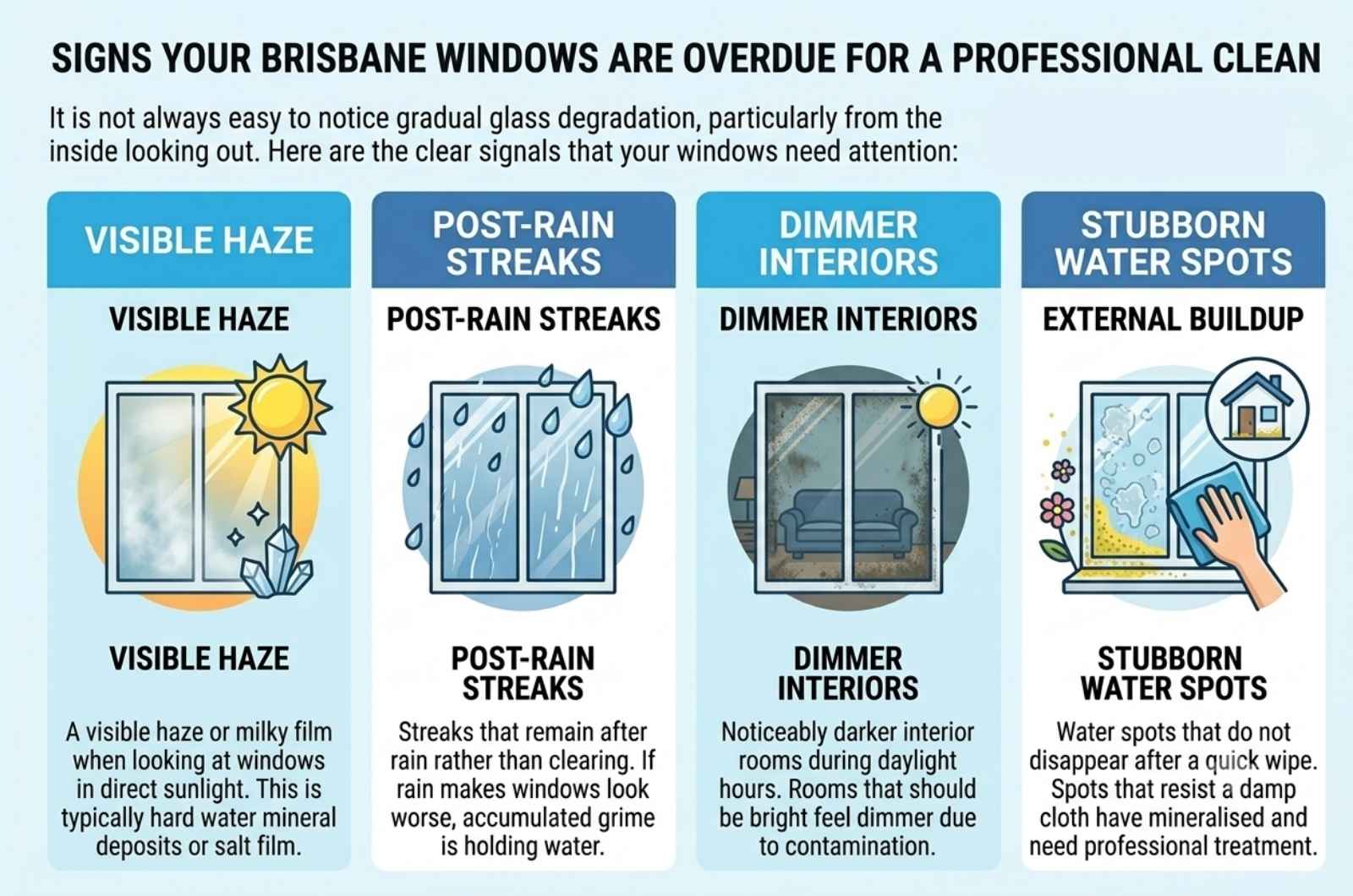
It is not always easy to notice gradual glass degradation, particularly from the inside looking out. Here are the clear signals that your windows need attention:
- A visible haze or milky film when looking at windows in direct sunlight. This is typically hard water mineral deposits or salt film.
- Streaks that remain after rain rather than clearing. If rain is making your windows look worse rather than better, the glass surface has enough accumulated grime to hold water rather than shed it.
- Noticeably darker interior rooms during daylight hours. If rooms that used to be naturally bright feel dimmer, window contamination is likely a contributing factor.
- Visible pollen or dust accumulation on external window sills and frames. If the frame is dirty, the glass will be too.
- Water spots that do not disappear after a quick wipe. Spots that resist a damp cloth have already mineralised onto the glass surface and require professional treatment.
How Much Does Window Cleaning Cost in Brisbane?
Window cleaning costs in Brisbane vary depending on the number of windows, the property type, access difficulty, and whether any specialist treatments are required for hard water or salt deposits. For a detailed national pricing guide, the Clean4you Window Cleaning Cost Guide for Australia covers typical price ranges by property size and service type.
As a general reference, a standard single-storey Brisbane home with a typical number of windows will usually fall within the $150 to $300 range for a professional clean.
Multi-storey homes, properties with difficult access, or those requiring hard water treatment will attract higher quotes.
Getting Your Brisbane Windows Professionally Cleaned
Knowing the right frequency is the first step. The next step is finding a reliable provider who understands Brisbane's specific environmental conditions and brings the right equipment and technique for the job.
Clean4you provides professional window cleaning services across Brisbane, including residential properties of all sizes, from apartments to large homes.
For those elsewhere in Australia, Clean4you also services Sydney, Canberra, Newcastle, Adelaide, Perth, and other major locations across the country.
If you are due for a clean or simply want to get a regular schedule in place that suits your property and location, it is worth getting a quote and locking in the right maintenance rhythm before Brisbane's next storm or pollen season arrives.
Frequently Asked Questions

Latest Blogs