TL;DR - Quick Answer
The Department of Veterans’ Affairs (DVA) funds cleaning and household support for eligible Australian veterans through two main pathways: the Veterans Home Care (VHC) Program and Household Services (HHS) compensation.
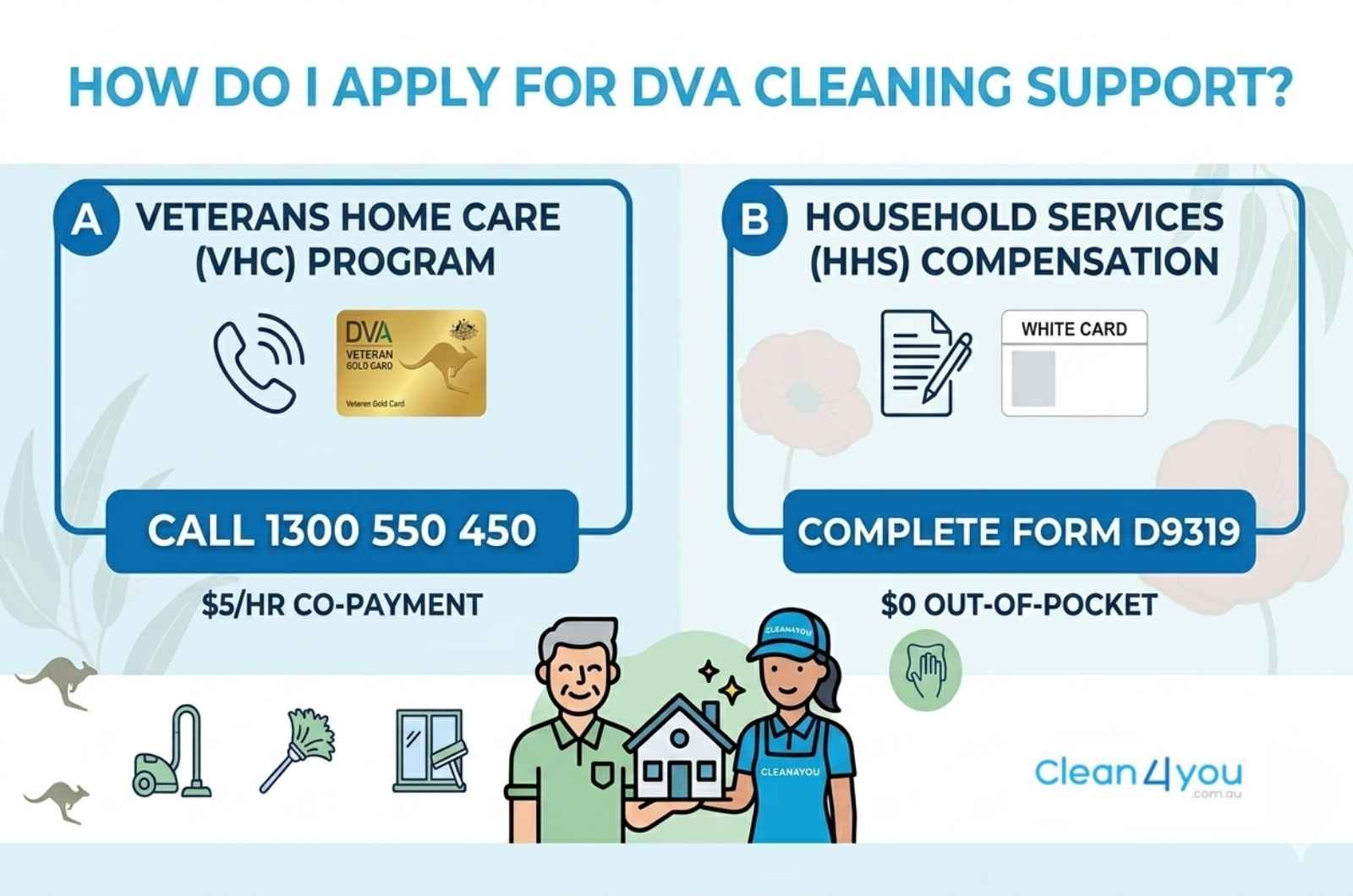
To apply for VHC, call the assessment agency on 1300 550 450. To apply for Household Services, complete form D9319 with your GP and submit it to DVA.
You need a DVA Gold Card or an eligible White Card to qualify. Most approved services are provided at little to no out-of-pocket cost.
If you are a veteran who finds it difficult to keep on top of household cleaning because of a service-related injury or health condition, DVA can help. The Department of Veterans’ Affairs has well-established programs that fund regular cleaning, laundry, window cleaning, and other domestic tasks so that eligible veterans can continue living independently at home.
This guide explains exactly who qualifies, which program is right for your situation, what the application process looks like, and what cleaning services are actually covered. Whether you are applying for the first time or helping a family member navigate the system, the information below covers everything in one place.
What Is DVA Cleaning Support?
DVA cleaning support refers to government-funded domestic assistance provided to eligible Australian veterans, war widows, and, in some cases, their carers, to help maintain a safe and liveable home environment.
According to the DVA, the department can provide help with cleaning and housekeeping to support veterans in remaining independent. The services provided are based on the individual’s eligibility and assessed needs.
DVA cleaning support is delivered through either the Veterans Home Care (VHC) Program or the Household Services (HHS) compensation program. Understanding which applies to you is the first step. The sections below explain the difference clearly.
DVA also offers access to broader aged care programs through My Aged Care for veterans aged 65 and over who need additional support beyond what VHC or HHS covers. These include the Commonwealth Home Support Programme and the Support at Home program, which replaced the Home Care Packages Program from 1 November 2025.
Who Is Eligible for DVA Cleaning Support?
Eligibility differs depending on which program you are accessing. Here is a breakdown of the requirements for each.
Veterans Home Care (VHC) Eligibility
You may be eligible for an assessment to receive services through VHC if you hold a:
- DVA Veteran Gold Card (All Conditions within Australia), or
- DVA Veteran White Card with an accepted service-related condition or Non-liability Health Care (NLHC)
In addition to holding one of these cards, you must:
- Be living at home (not in a residential aged care facility)
- Have difficulty performing daily activities without help due to functional limitations
Carers and family members of Gold Card and White Card holders with an accepted service-related condition may also be eligible for a VHC assessment, which is a point many people miss when looking into this program.
Household Services (HHS) Compensation Eligibility
Household Services compensation is a separate program from VHC. It is available specifically to veterans (not war widows or dependents) whose accepted service-related injury or condition under either the Military Rehabilitation and Compensation Act 2004 (MRCA) or the Safety, Rehabilitation and Compensation (Defence-related Claims) Act 1988 (DRCA) prevents them from managing household tasks they were responsible for before their injury.
To be eligible for Household Services compensation, you must:
- Be unable to independently manage household tasks you were responsible for before your injury or illness
- Have a condition accepted as service-related under the MRCA or DRCA
- Be assessed as having a reasonable requirement for household services
- Be living at home
You cannot receive Domestic Assistance or Home and Garden Maintenance from both VHC and Household Services at the same time. If you are already receiving these through Household Services compensation, you cannot also claim the same services through VHC. However, Respite Care is only available through VHC and is not affected by this rule.
VHC vs Household Services: Which Program Is Right for You?
Understanding the difference between these two programs is important before you apply. They exist for different reasons, have different application processes, and different cost structures.
| Feature | Veterans Home Care (VHC) | Household Services (HHS) |
|---|---|---|
| Who can access it | Veterans, war widows, eligible carers, and family members | Veterans only |
| Basis of eligibility | Functional limitation affecting daily living | Accepted service-related condition under MRCA or DRCA |
| Card required | Gold Card or eligible White Card | Gold Card or eligible White Card |
| Cost to Veteran | Small co-payment of $5 per hour (waiver available) | No out-of-pocket cost; fully funded by DVA |
| How to apply | Call 1300 550 450 for a phone assessment | Complete form D9319 with your GP and submit to DVA |
| Assessment type | Needs-based functional assessment by phone | Medical and clinical assessment by DVA |
| Service intensity | Low-level, practical support at home | Customised to the severity of the condition; can be higher intensity |
If you have accepted conditions under MRCA or DRCA, DVA requires you to be assessed for Household Services or Attendant Care before being assessed for VHC. VHC does not duplicate services that you already receive under these programs.
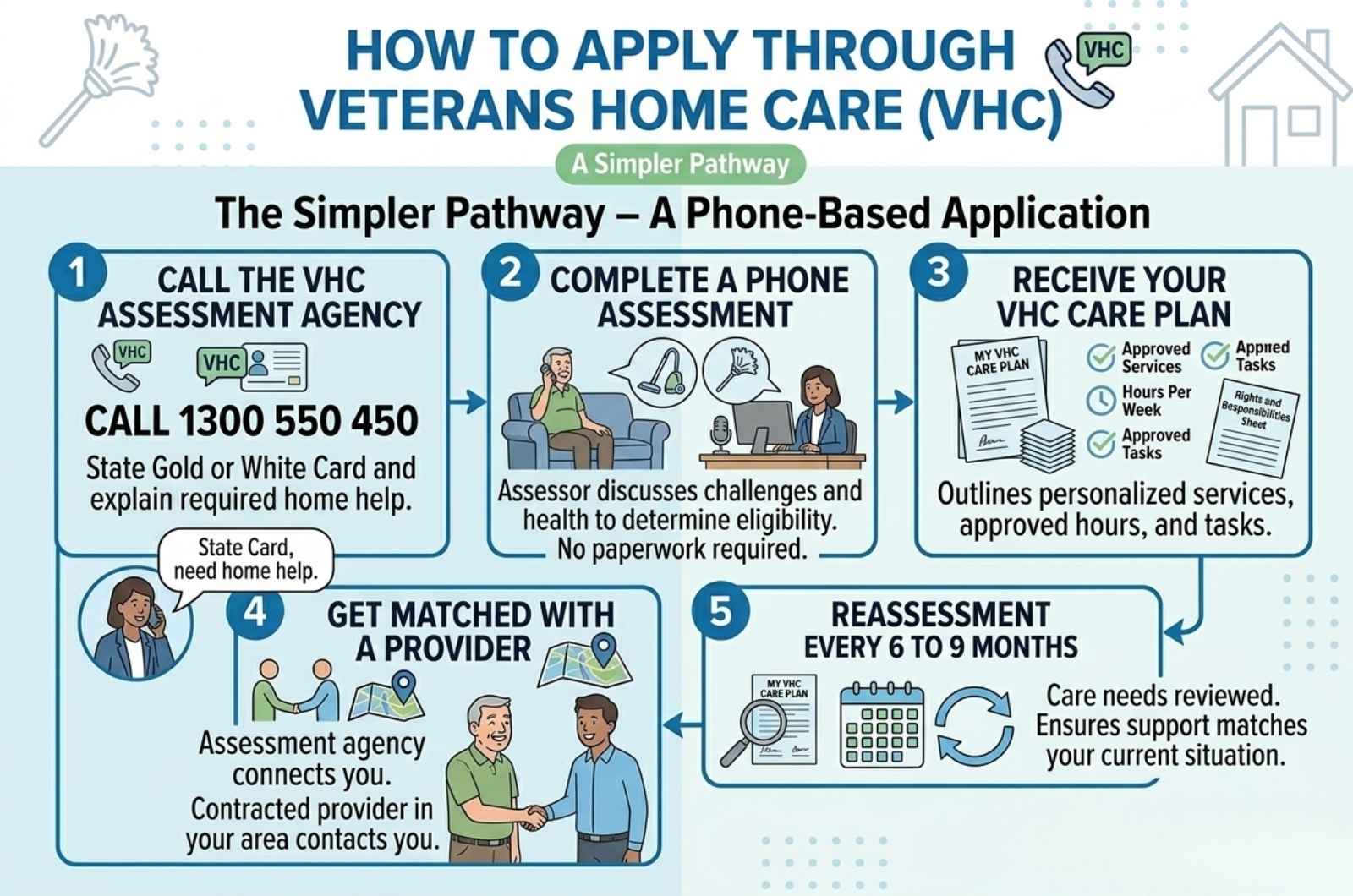
How to Apply Through Veterans Home Care (VHC)
Applying through the VHC program is the simpler of the two pathways and can be done entirely over the phone.
Step 1: Call the VHC Assessment Agency on 1300 550 450
This is the dedicated number for arranging a VHC assessment. The assessor will discuss your circumstances by phone to identify the range, frequency, and duration of services required. When you call, state that you are a Gold or White Card holder and explain what type of home help you need.
Step 2: Complete a phone assessment
The VHC assessor goes through your daily living challenges, home environment, and health situation. They use this to determine your eligibility and the level of support you need. There is no paperwork required on your part for this initial step.
Step 3: Receive your VHC Care Plan
If approved, you receive a personalised care plan outlining the specific services, hours per week, and approved tasks. A VHC Rights and Responsibilities Information Sheet is provided alongside your care plan.
Step 4: Get matched with a VHC service provider
The assessment agency connects you with a contracted VHC service provider in your area. They contact you to schedule services at suitable times. You do not need to find a provider yourself.
Step 5: Reassessment every 6 to 9 months
Your care needs are reviewed every 6 to 9 months to make sure the services continue to match your situation. This keeps your support appropriate as your circumstances change.
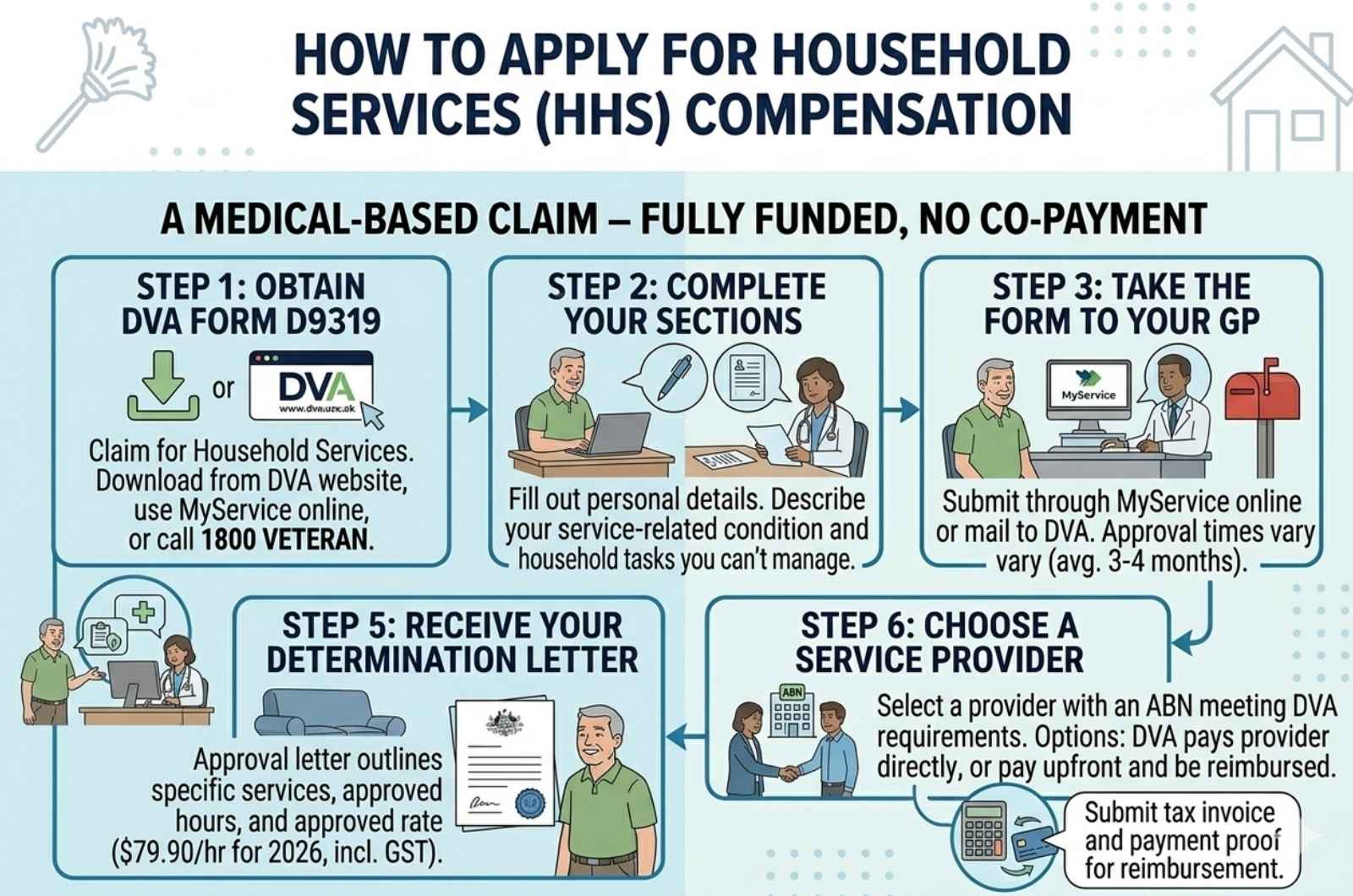
How to Apply for Household Services (HHS) Compensation
Applying for Household Services compensation is a slightly more involved process because it requires a medical assessment from your treating GP. However, it results in a fully funded service with no co-payment.
Step 1: Obtain form D9319 (Claim for Household Services)
This is the official DVA claim form for Household Services. You can download it from the DVA website, access it through MyService online, or call 1800 VETERAN (1800 838 372) for assistance obtaining the form.
Step 2: Complete your section of the form
You fill out the sections about your personal details, the nature of your service-related condition, and the specific household tasks you can no longer manage because of that condition.
Step 3: Take the form to your treating GP
Your GP completes the medical section of the form. This includes confirming the nature of your accepted service-related condition, how it affects your ability to carry out domestic tasks, and what level of support is clinically appropriate. Give your GP enough time to complete it thoroughly.
Step 4: Submit the completed form to DVA
Submit form D9319 through MyService online or by mail to DVA. Approval times vary. In general, DVA takes approximately 3 to 4 months to process a claim from the date of submission.
Step 5: Receive your Determination Letter
If approved, DVA sends a Determination Letter outlining the specific services you can access, the hours approved, and the approved provider rate. For 2026, the standard maximum rate service providers may charge is $79.90 per hour, inclusive of GST.
Step 6: Choose a suitable service provider
You select a provider that holds an Australian Business Number (ABN) and meets DVA requirements. DVA can pay your provider directly, or you can pay upfront and be reimbursed by submitting the tax invoice and proof of payment. Either option is available to you.
Processing time for Household Services claims is typically 3 to 4 months. Start the application as soon as possible and do not wait until your need becomes urgent. In the meantime, VHC may be able to provide some interim support.
What Cleaning Services Are Covered by DVA?
DVA-funded cleaning services focus on practical household tasks that help veterans maintain a safe, hygienic, and manageable home. The following services can be provided under the domestic assistance category:
- Internal household cleaning, including vacuuming, dusting, and bathroom maintenance
- Dishwashing
- Washing and ironing clothes and household linen
- Bed-making
- Some meal preparation assistance
- In rural and remote areas, tasks such as collecting firewood may also be included
Under the home and garden maintenance category, DVA also funds:
- Window cleaning (internal and external), typically on an annual basis
- Gutter cleaning (typically annually)
- Cleaning of ceiling fans and air conditioning split system units
- Replacing light bulbs and changing smoke alarm batteries
- Lawn mowing and basic garden maintenance
DVA cleaning support does not include nursing care, luxury cleaning services, or tasks outside the veteran’s approved determination. As a general rule, DVA cannot fund family members to provide these services. Services outside your DVA-approved list that exceed the approved allowance may incur out-of-pocket costs.
How Much Does DVA Cleaning Support Cost?
Understanding the cost structure of DVA cleaning support depends on the type of program a veteran is approved under.
Household Services (HHS): No out-of-pocket cost
For veterans approved under Household Services compensation (MRCA or DRCA), DVA pays the service provider directly. There is no out-of-pocket cost to the veteran for approved services. The standard maximum rate providers can charge for the 2026 calendar year is $79.90 per hour, inclusive of GST, up from $76.55 per hour in 2025.
Veterans Home Care (VHC): $5 per hour co-payment
Veterans receiving services through the VHC program are asked to contribute a small co-payment of $5 per hour. There is a cap on the total co-payment amount per service type. There is no co-payment for Respite Care services. If the co-payment is genuinely unaffordable, you can apply for a co-payment waiver, though eligibility criteria apply.
“DVA sets the hourly rate for household services and pays providers directly. Eligible veterans do not pay anything out of pocket for approved services under Household Services compensation.”
Can I Access DVA and Aged Care Services at the Same Time?
Yes, but with conditions. DVA services can run alongside other government-funded aged care programs as long as the services do not overlap.
For example, if you receive DVA-funded cleaning services that fully meet your assessed need, you cannot access additional cleaning services through other aged care programs such as the Commonwealth Home Support Programme or the Support at Home program.
However, if DVA services only partly meet your needs, you can apply for an assessment through My Aged Care to determine whether additional in-home aged care services can be arranged to fill the gap.
For veterans aged 65 and over who need an aged care assessment, you can apply through My Aged Care in three ways:
- Online at the My Aged Care website using the Apply for an Assessment form
- By phone: call My Aged Care on 1800 200 422 (weekdays 8 am to 8 pm, Saturdays 10 am to 2 pm)
- In person: book an appointment with an Aged Care Specialist Officer by calling 1800 227 475 (Monday to Friday, 8 am to 5 pm)
There is often a significant wait time for My Aged Care services following assessment, sometimes between 3 and 12 months, depending on the service and location. DVA strongly recommends applying for an aged care assessment early if you think you may need it in the future.
Key Legislative Changes From 1 July 2026
From 1 July 2026, major reforms to the DVA system will come into effect. The Veterans’ Entitlements Act 1986 (VEA) and the Safety, Rehabilitation and Compensation (Defence-related Claims) Act 1988 (DRCA) will be closed to new compensation and rehabilitation claims. From that date, all new claims will generally be assessed under an improved Military Rehabilitation and Compensation Act 2004 (MRCA) framework. Existing payments under VEA and DRCA will continue under transitional “grandfathered” arrangements, and veterans already receiving approved support will not need to reapply.
What this means practically:
- Veterans who were previously assessed under different schemes may have their new claims processed under the expanded MRCA framework from 1 July 2026, creating a more consistent single pathway for new applications
- DRCA veterans transitioning into the new system may be eligible for updated benefit structures aligned with MRCA-style assessment and support arrangements, depending on their circumstances and claim type
- Some claims may be processed more efficiently due to streamlined assessment rules and broader standardisation under MRCA, but eligibility will still be assessed case by case
- Veterans currently receiving Household Services or Attendant Care under MRCA, VEA, or DRCA will generally continue their existing arrangements under transitional protections, with no automatic change to approved services
If you are currently receiving Household Services or Attendant Care under the MRCA, your services will continue unchanged after 1 July 2026. No action is required from you.
Quick Summary:
- DVA funds cleaning and household services for eligible veterans through two programs: VHC and Household Services compensation
- VHC requires a Gold Card or an eligible White Card and a functional limitation; apply by calling 1300 550 450
- Household Services compensation requires an accepted service-related condition under MRCA or DRCA; apply using form D9319, completed with your GP
- VHC involves a $5 per hour co-payment (waivable); Household Services has no out-of-pocket cost
- Covered services include regular house cleaning, laundry, ironing, window cleaning, gutter cleaning, and lawn maintenance
- DVA can pay your provider directly; you do not need to pay upfront for Household Services
- From 1 July 2026, all new claims will be assessed under the MRCA regardless of the previous Act
- Apply early, as processing times can take 3 to 4 months for Household Services claims
Already Approved for DVA Cleaning Services?
If you already have your Determination Letter or a VHC Care Plan in place, the next step is simply choosing a trusted provider to carry out your approved services.
Clean4you provides DVA Household Cleaning Services for eligible veterans across Australia, helping maintain a clean, safe, and comfortable home environment in line with DVA-approved requirements.
We service major locations including Newcastle, Sydney, Melbourne, Perth, Adelaide, Brisbane, Canberra, Gold Coast, Central Coast, Wollongong, and surrounding areas across Australia.
Frequently Asked Questions

Latest Blogs